‘An island on the Edge of the World’ A Trip to St Kilda in 2021 Andrew Morton
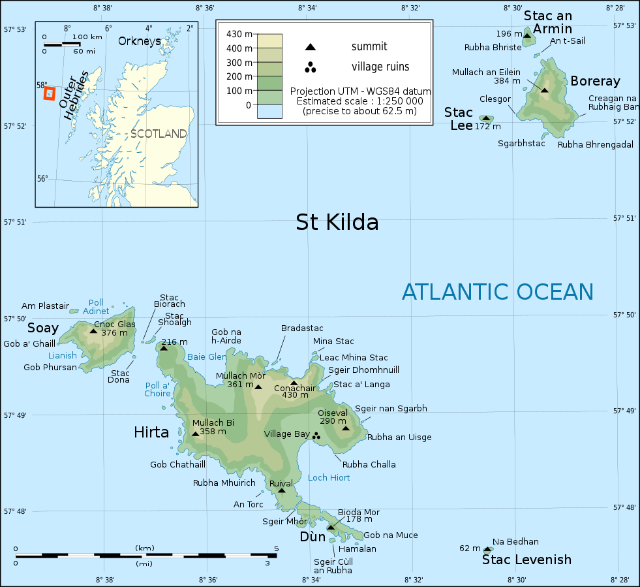
Charles Maclean, born in 1946, like me, and son of Sir Fitzroy Maclean of Strachur, described St Kilda in those words, in the title of his book on the island and its history. My parents knew Sir Fitzroy, as they lived in Strachur for over twenty years. So there was a modest link with St Kilda which led me to want to read about it and to visit it at some point in my ‘boaty’ wanderings. The opportunity arose last summer (2021), towards the end of June, when a settled spell of weather appeared in the forecast. My boat is normally moored at Largs, so I was looking at a distance of almost 300 nautical miles, a fair bit of which was crossing open ocean. ‘Tiptoe’ is not a big boat, only 25 feet long, with a single 225 hp Volvo Penta inboard engine, and many are surprised at my venturing so far offshore in such a small craft. But I took her to Shetland and back in 2019, and my trip there was covered in the July 2020 edition of ‘Motor Boat and Yachting’.
The key to success is planning of course, and that includes picking the right weather. As you will see from the summary log at the end of this article, wind was not a problem for me, during the seven days it took me to get from Largs to St Kilda and back to Craobh Haven, a beautiful marina just south of Oban, where I often stay for extended periods. If you haven’t been there, it’s a must.
I took my kayak with me – I always do. It adds so much to the experience. I can’t impress upon you more, the need to carry a kayak with you on your boat. There are two simple reasons: firstly, it enables you to explore inaccessible parts of the coastline where your boat won’t go, and secondly, it keeps you fit. The yachties look down on our ‘press-and-go’, ‘non-green’ mentality, so we have to fight back on every front!
Back to the plot. Those not familiar with the west coast of Scotland can get their map/chart out and check my progress, along with my log. To be honest, there’s nothing to beat the west coast of Scotland for cruising, so long as the weather is good – and that’s the catch of course. You will note that the dates are very close to mid-summer, and yet the air temperature was sometimes lower than London in mid-winter. That’s something to remember for sure. But a huge bonus is day length. At the end of June, sunrise in the Outer Hebrides is at 04.30, and sunset at 22.30, so it never really gets dark at night, and cruising time and range are therefore extended considerably, which is particularly useful for long trips, and timing departures to catch the tide. Often too, the wind is less strong early in the morning, to make early morning starts a real pleasure. My most memorable early start of the cruise to St Kilda, was leaving Hirta, the main island of the St Kilda archipelago, and motoring four miles across to Boreray as the sun rose over the horizon. The least enjoyable, was the departure from Colonsay in the mist, and then crossing the open ocean to Berneray and Mingulay, all the time in poor visibility of around just 200 metres. The chartplotter an essential piece of kit.
The highlight of the trip was two-fold: visiting both St Kilda and the Monach Isles, in remarkably good weather. Both are hugely contrasting archipelagos – one the craggy remains of an ancient volcano, and the other low-lying and sandy. The snag with Hirta, is that there is really only one decent sheltered bay, and it’s a bit open to southerly winds. So that limits the weather in which you can approach and stay at the island. As it happened, the wind died and the sun came out on the afternoon of my arrival, which allowed me to kayak round the island, go ashore in the evening to explore, and stay the night.
Firstly, the trip to the island itself: Tiptoe has only one engine, and is 10 years old, with 1,300 hours on the clock. Why not a back-up outboard? I made the decision not to buy one when I bought the boat, for six reasons:
1. The cost – I’m a Scot. 😊
2. The engine takes up space on the stern of the boat, where I need space to launch my kayak and tender, and for less nimble passengers to gain easy access
3. The engine and fuel add weight to the boat
4. The fuel is petrol, which I’d rather not carry
5. The likelihood of requiring the backup would be very low
6. I’ve got many other systems to help me in distress:
VHF radio
PLB (Personal Locator Beacon)
A tender + lightweight spare, which would need to be inflated
Two anchors, each with chain and combined length of 80 metres
A sea anchor
A mobile phone
A regular subscription to the RNLI!
If I had bought an outboard at the outset, I would have been carrying it, plus a can of petrol with me for ten years, to no purpose at all. Keep in mind too, that many larger commercial boats, only have a single engine, with no backup. So I’m not alone in my decision. In an ideal world I’d like a boat with two completely separate engines, but at present I run with one, which is much more economic of course.
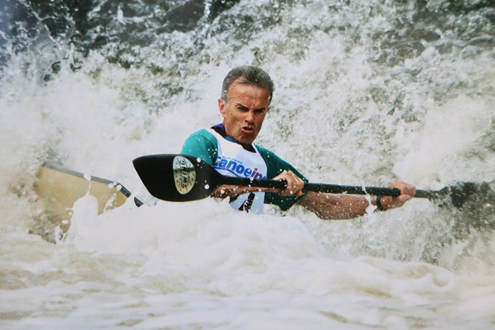
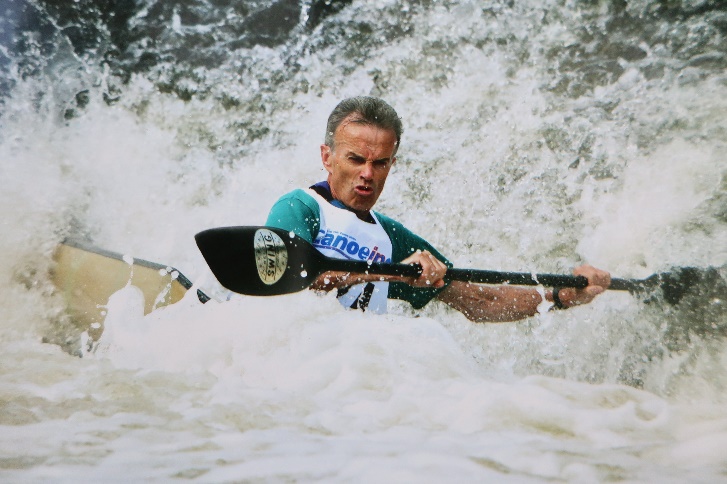 Does it bother me? Yes, just a little. On my trips to both Shetland and St Kilda, there were moments when the lack of backup crossed my mind, and I hoped all would be well. It’s a risk, but we all take risks, and we weigh up the pros and cons. Driving to the boat in my car is a risk I’m prepared to take, as is climbing the stairs in my house. Certainly, kayaking down rapids is a major risk, which I used to take many years ago. I do have the kayak with me, in which I can sustain 5 knots for over three hours, but it’s impossible to get into my kayak off the swim deck if it’s anything other than fairly calm. So, that’s a no-no. And why leave the boat, unless it’s sinking?
All this is part of the adventure of course: setting off solo from Largs, with the aim of reaching St Kilda, was a real thrill. Loaded up with fuel, food and drink, a kayak on the roof, a folding bike below, all set to explore the islands of Scotland, and to do so, almost entirely alone, miles from civilisation. ‘Tiptoe’ has all the mod cons: fridge, cooker, separate toilet and hot shower, three berths, two heaters, auto-pilot with remote, bow thruster and electric anchor winch. So, it’s a perfect cruising package + kayak and Brompton bike. What’s not to like.
Anchored in Village Bay with Dun in background
What of the islands themselves? If you plan to visit, first read about them. That will make your visit so much more relevant and interesting. The last inhabitants left St Kilda in 1930, but there is much evidence of their presence still to see. The most remarkable being the hundreds of cleits scattered over Hirta, like currants on a cake. They were built to store and dry food, birds in particular – puffins, gannets and fulmars, to name but three.
The other notable feature was the presence of the military. St Kilda occupies a key spot in the Atlantic, very useful for keeping an eye on passing trade – friend and foe. So there was much activity, which rather spoils the experience of exploring a remote island. However, the reception from all was friendly and generous, and much appreciated. The highlight of the visit was paddling round Hirta in my kayak, a distance of just over 8 miles, which I did in an hour and a half. After a bite to eat on Tiptoe to recharge the batteries, I went ashore again in my dinghy, and walked to the top of Mullach Bi, to take pictures as the sun set over the Atlantic. The climb of 1,000 feet is steep, but an absolute must, if the weather is clear.
Cleits, and Dun in the evening sun
On return to my boat, the National Trust RIB came by. Word had got round that I had paddled round the island rather quickly, and one of the young men on the RIB shouted across, “Do you remember me Mr Morton? You taught me Biology at Dollar Academy many years ago.” Well, I did remember him, and returned his compliments. He’s now the RSPB warden. So some passion for the birds and bees must have rubbed off at some point in his education. What a small world it is.
As the weather had improved so much, I decided to stay the night in Village Bay. The following morning was glorious, and I took Tiptoe across to Boreray, just four miles from Hirta. Not a soul about of course, which adds to the experience, just the feral Soay sheep, and thousands of sea birds. The ancient volcanic island rises straight out of the ocean, so you can bring the boat up to the rocks within touching distance no problem at all. How the St Kildans managed to go ashore and stay for days to catch birds, stretches the imagination. I have to say, the gentle cruise round the island in the morning sun and calm seas, miles from the mainland, was an experience I will not forget.
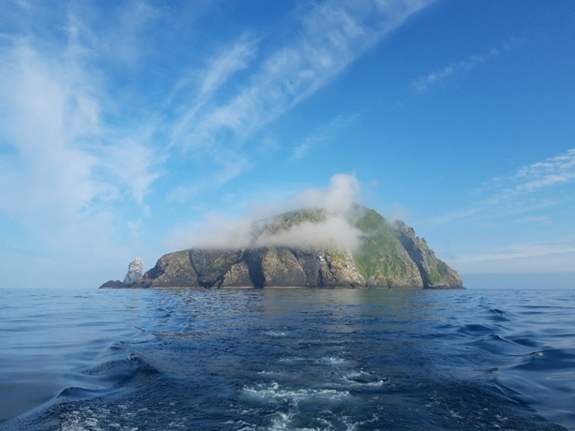
Boreray
At the Monach Isles – Marlin river racer with rudder – brilliant for sea paddling. Av speed over 5 knots.
10kg, T-bar + understern rudder. Bespoke build by JEM composites in Wales.
On then to the Monach Isles, totally different in so many respects.
They are not volcanic, and not too long ago in Geological time, they were attached to the mainland of the Hebrides, and inhabited. What a contrast, paddling round the shallow sandy bays in my kayak in the warm sun. Again, totally solo – not a soul to be seen. Such a privilege to be able to visit these remote spots, explore the deserted beaches of Monach, and the caves and cliffs of St Kilda, and view these islands in all their glory and desolate splendour.
Moored at Monach
And the trip back from Monach Isles to Craobh Haven? Quick and easy, and trouble free.
Mini Log of trip to St Kilda and Monach Isles (2021)
(M = Marina A = Anchor)
This article appeared in ‘MotorBoat and Yachting’,